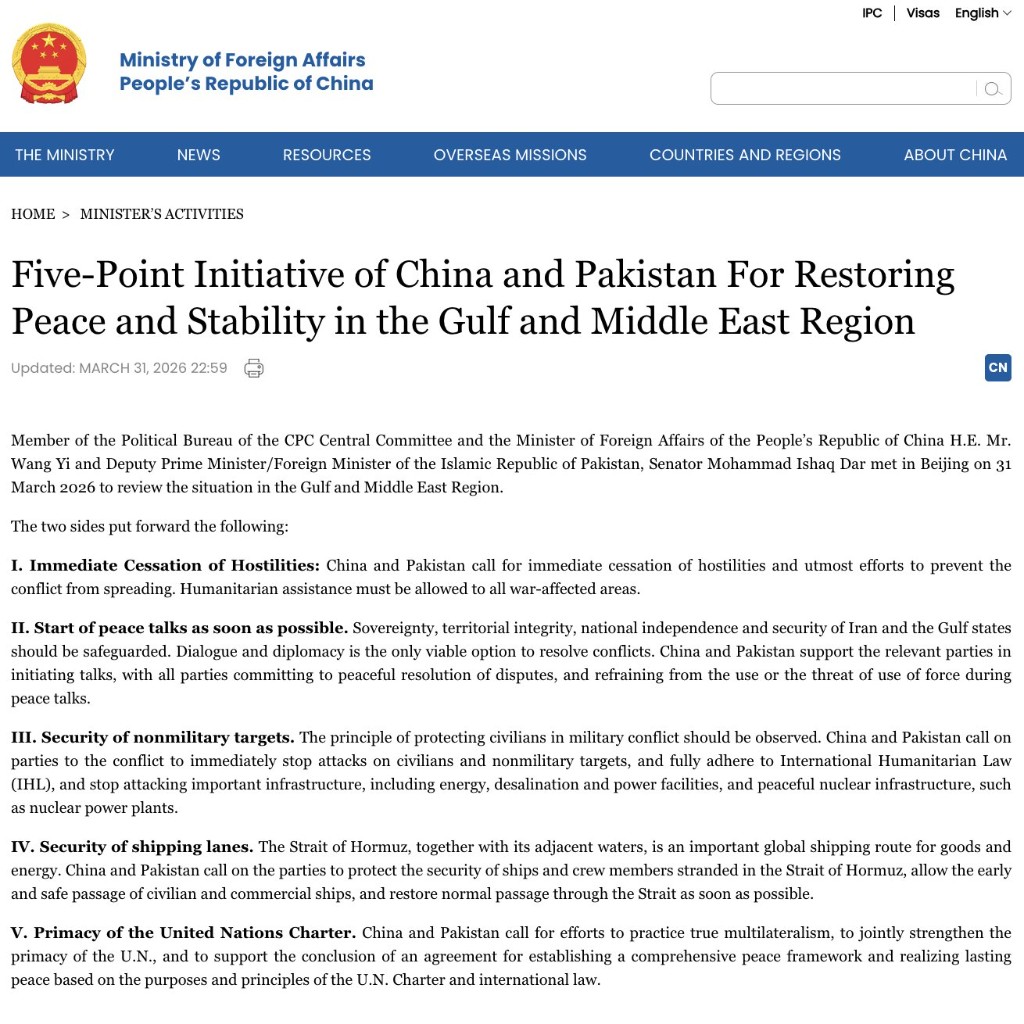
The military escalation in the Middle East, ignited by coordinated US and Israeli strikes on February 28, 2026, has severely disrupted the region and the global economy. To solve this complex challenge, the international community must remain calm, avoid further escalation, and urgently implement a 30-day humanitarian ceasefire. Fortunately, a viable roadmap has just emerged. On March 31, 2026, China and Pakistan released a joint Five-Point Initiative for restoring peace and stability in the region. By adopting this framework, which prioritizes the cessation of hostilities, the protection of nonmilitary targets, the security of shipping lanes, and the primacy of the UN Charter, the international community can create the conditions for a negotiated settlement endorsed by a binding UN Security Council resolution.
Securing Shipping Lanes and Global Trade
The China-Pakistan initiative emphasizes the urgent need to secure shipping lanes, specifically the Strait of Hormuz. As one of the world’s most critical maritime chokepoints, the Strait normally carries approximately 20 million barrels of oil per day, alongside one-fifth of the world’s liquefied natural gas (LNG) and up to 30 percent of fertilizers. Since hostilities broke out, tanker traffic through the Strait has collapsed by more than 90 percent.
The shock is already global: oil and gas benchmarks have spiked, and the WFP projects that sustained $100-plus oil could push nearly 45 million more people into food insecurity. Fertilizer prices have climbed as well, with granular urea from the region increasing by 19 percent in the first week of March.
Furthermore, restoring normal passage through the Strait is a pressing humanitarian issue. Approximately 20,000 civilian seafarers remain stranded in the Persian Gulf. As of March 24, 2026, the International Maritime Organization (IMO) reported 18 incidents near the Strait, resulting in several casualties, including four fatalities from an attack on March 6. Innocent civilians must never be targets of war.
Protecting Civilians and Nuclear Infrastructure
Point III of the joint initiative demands the immediate cessation of attacks on civilians, infrastructure, and peaceful nuclear facilities. Within Iran, military strikes are causing economic degradation and rapid de-development of the civilian population. According to a March 31, 2026, preliminary impact brief by the United Nations Development Programme (UNDP), the conflict is projected to cause a real GDP contraction of between 8.8 and 10.4 percentage points.
The human toll has also been staggering. By the UN Development Programme’s end-March estimate, more than 1,900 Iranians had been killed and up to 3.2 million displaced, with the shock threatening to drive the national poverty rate toward 41 percent. Tragically, Iran’s Human Development Index (HDI) is projected to decline by 0.47 to 0.56 percentage points, erasing roughly one to one-and-a-half years of human development.
Furthermore, attacks on IAEA-monitored nuclear sites and civilian infrastructure further violate the basic purposes of the UN Charter and the IAEA Statute. Protecting these sites, as explicitly called for by China and Pakistan, is paramount. The international community should continue to work, through a number of creative diplomatic solutions, towards a durable settlement that pairs Iran’s commitment against nuclear weapons with its right to civilian enrichment. Options include the nuclear consortium that was a proposal previously floated in 2025, or the Fissile Material Cut-Off Treaty (FMCT). The FMCT, a non-discriminatory, verifiable treaty banning the production of fissile material for weapons, remains a logical step to strengthen the non-proliferation regime and could bring both the United States and Iran to the table if sufficient political will exists.
Diplomacy and the Primacy of the United Nations
Points I, II, and V of the China-Pakistan framework call for an immediate cessation of hostilities, the swift initiation of peace talks, and the safeguarding of multilateralism through the UN Charter.
The groundwork for this UN-led approach is already taking shape. On March 27, UN Secretary-General António Guterres established a dedicated Task Force on the Strait of Hormuz. Headed by Jorge Moreira da Silva (Executive Director of UNOPS), and including representatives from UNCTAD, the IMO, and the ICC, the Task Force aims to stabilize maritime transit for humanitarian purposes, focusing initially on fertilizer trade to mitigate food insecurity. At the same time, veteran diplomat Jean Arnault has been appointed as the Personal Envoy to lead UN mediation efforts.
Path to Peace
Two rival blueprints exist. Iran’s own proposal seeks war reparations and recognition of its sovereignty over the Strait of Hormuz; Washington’s plan demands an end to enrichment and limits on Iran’s missiles. The China-Pakistan initiative, on the other hand, opens with a ceasefire and civilian protection while leaving the hardest questions to negotiation, which is exactly why it can move first.
While these UN steps are crucial, immediate action on the ground is required to operationalize the Sino-Pakistani vision. I call for an immediate 30-day humanitarian ceasefire to prevent further loss of life, halt the rapid de-development of the region, and fulfill the Five-Point Initiative of China and Pakistan For Restoring Peace and Stability in the Gulf and Middle East Region.
This proposed ceasefire will serve as a necessary trust-building exercise towards a negotiated settlement, ultimately to be enshrined in binding international law through a UN Security Council resolution. The international community cannot afford to wait. The irrecoverable loss of human life and the de-development of the Iranian people are simply too high a cost.
Kian Jamasbi holds a Juris Doctor from Fordham University School of Law, with a concentration in International, Comparative, and Foreign Law. He earned a Bachelor of Science in Economics from the University of Michigan, Ann Arbor. His professional website is kianjamasbi.com. He is the founder of Oxuz News, where this commentary is published.
References
- Arms Control Association. Fissile Material Cut-off Treaty (FMCT) at a glance. Retrieved March 31, 2026.
- Bulletin of the Atomic Scientists. (2025, June). A nuclear consortium in the Persian Gulf as a basis for a new nuclear deal between the United States and Iran.
- Food and Agriculture Organization of the United Nations (FAO). (2026). FAO chief economist warns of severe global food security risks from disruption to Strait of Hormuz trade corridor.
- International Committee of the Red Cross (ICRC). Protected persons and civilians. Law and Policy. Retrieved March 31, 2026.
- International Maritime Organization (IMO). (2026). Hot topics: Middle East — Highlighted incidents.
- International Maritime Organization (IMO). (2026). Hot topics: Middle East — Strait of Hormuz.
- Ministry of Foreign Affairs of the People’s Republic of China. (2026, March 31). Five-Point Initiative of China and Pakistan for restoring peace and stability in the Gulf and Middle East region.
- United Nations. (2026, March 27). Note to correspondents: The Strait of Hormuz. United Nations Secretary-General.
- United Nations Conference on Trade and Development (UNCTAD). (2026). Strait of Hormuz disruptions: Implications for global trade and development.
- United Nations Development Programme (UNDP). (2026). Military escalation in the Middle East: Economic and human development impacts on the Islamic Republic of Iran.
- United Nations News. (2026, March).
- World Food Programme (WFP). (2026). WFP projects food insecurity could reach record levels as a result of Middle East escalation.